Sunday, July 29, 2012

Whether the Weather


There is a passage in a recent short story by Lorrie Moore, called “Referential,” that goes like this:
There was a storm looming, and lightning did its quick, purposeful zigzag among the clouds. She did not need such stark illustration that horizons could be shattered, filled with messages and broken codes, yet there it was. A spring snow began to fall with the lightning still cracking .... She knew that the world had not been created to speak just to her, and yet, as for her son, sometimes things did.
This is, I think, a particularly lovely example of something I see again and again, in works of fiction, poetry, even news reports: a moment, a pause, as a person takes in the weather and wonders if it might be meaningful. (Maybe this, even more than if it will rain or snow, is the real “whether” of the weather.) Here, the protagonist is driving home after visiting her mentally ill son at the institution where he lives, and for a moment, like him, she sees “messages” in “things.” (I love that weather, here, is a “thing”—because it is.) The message in the lightning, its “broken code,” tells her that her “horizons” can be “shattered”—and really, is there any clearer illustration of chance, of uncertainty, than the weather? All the same, the message is “broken”: weather is at once clear and inscrutable.

In this moment, the moment of this writing, I’m sitting at my desk, in south St. Louis city, listening to the low rumble of distant thunder, as the first rain we’ve had in weeks falls gently outside my window. It’s been terrible here, weather-wise—sublime, really, which is just another way to say it’s been godawful. We’ve had temperatures above 100 almost every day in July. It hasn’t rained. There haven’t even been clouds, for the most part, until this past week, when they materialized and loomed spectacularly over the city, and brought no rain. Stepping outside in this weather is like walking into a wall. It is hard, a fact. As such, it’s hard to know what to say about it, but we talk about it anyway.

And of course, we talk about global warming. Again, no one is saying this is global warming, but a lot of people, including climate scientists, have allowed that it is a kind of “preview” of global warming. It’s a hell of a preview. I honestly don’t know how we’d manage a string of summers like this one, not to mention a string of winters like the last one, when it snowed, lightly, only two or three times and temperatures rarely fell below freezing.

Wondering if weather is meaningful is not so different from wondering if weather is global warming.

I’m a midwesterner, and I feel a kind of panic when I imagine midwestern winters without snow. I’m not sure what, exactly, would be lost, but it’s something like meaning. There is talk now among those of us who think critically about ecology that despair may be a real and even useful (and perhaps our only) option.

For the moment, I’ll defer to Scott Fitzgerald. I came across this lovely passage in my most recent reading of The Great Gatsby:
When we pulled out into the winter night and the real snow, our snow, began to stretch out beside us and twinkle against the windows, and the dim lights of small Wisconsin stations moved by, a sharp wild brace came suddenly into the air. We drew in deep breaths of it as we walked back from dinner through the cold vestibules, unutterably aware of our identity with this country for one strange hour before we melted indistinguishably into it again.

Thursday, April 26, 2012

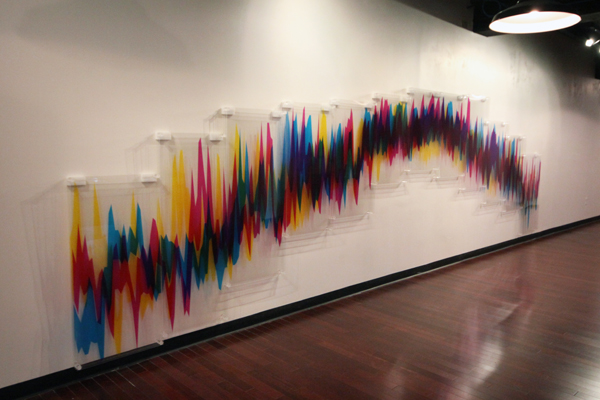
Speaking of conceptual weather art ... here's my review of ˚ by Stephen Cartwright and Andrew James, at the Luminary Center for the Arts in St. Louis.


Tuesday, April 24, 2012

What is it with conceptual poetry and weather?

Well, maybe there isn’t that much conceptual weather poetry. But there is some. (As well as some conceptual weather art—more on this soon.)

While making my way through Craig Dworkin and Kenneth “The Weather” Goldsmith’s Against Expression: An Anthology of Conceptual Writing (which I find by turns thrilling and numbing—what makes good conceptual writing?—a simple concept, surely, and a degree of art, accidental or otherwise—not everyone will agree) I came across an excerpt from Gregory Betts’s If Language, exactly the kind of conceptual work I most enjoy. As it happens, the excerpt in Against Expression includes a weather poem. First, though, this is how it works: each of the fifty poems in If Language is a different arrangement of the same 525 letters in a passage from an essay by Steve McCaffery. To give you a sense of what this is like, here is the McCaffery passage:
If Language Writing successfully detaches Language from the historical purpose of summarizing global meaning, replacing the goal of totality with the free polydynamic drive of parts, it nevertheless falls short in addressing the full implications of this break and seems especially to fail in taking full account of the impact of the human subject with the thresholds of linguistic meaning. It is at the critical locus of productive desire that this writing opens itself up to an alternative “libidinal” economy which operates across the precarious boundaries of the symbolic and the biological and has its basis in intensities.
And here is Betts’s weather poem:
Today it will be music degrees of collage with a litter of sun petroleum and solace, hi-fi of sickishness, obliged by a conservative force that, it is hopeful, will fulminate in the social realities of committed principalities. Someone’s parents slip back into an ungracious war front that agitates the alliance and physiognomy of illuminating gases threatening shift. By tonight, at the mausoleum parade, the light scoffing carbuncular air should eroticize its partly visible superobjectivism. Plush gallows hiss. There is a fifty percept chance of fifth and eighth dimensions contrasting that should clear up all things considered.
I am amazed at the virtuosity of Betts’s anagrams. (I should also mention that the blurb for If Language, by the conceptual writer Christian Bök, is an anagram of the McCaffery passage, as well.) To my eye (my ear, my mind) this poem is just, well, perfect. I especially like “hi-fi of sickishness,” “the mausoleum parade,” and “the light scoffing carbuncular air should eroticize its partly visible superobjectivism”—although I can’t say particularly why I like it. It reminds me that every word is an arrangement of letters, every sentence an arrangement of words, and that arrangement itself is meaningful, even when I don’t know exactly what this arrangement of letters and words means. (I’m typing this in Microsoft Word, and I’m kind of tempted to turn on the grammar check, to see what it makes of Betts’s sentences.)

Betts’s poem is like a weather forecast, right? But how? I’ve struggled to find a way to say this. The same is true of parts of Clark Coolidge’s “Weathers.” There’s a passage that begins, “Partly stone only to see beneath red slips. The fishing particle, on and off, innards of glass. Sun parts hardly, seems to move.” That “partly stone” and “sun parts hardly” suggest something like “partly sunny”—and of course, rain, snow, wind and so on are often “on and off.” Coolidge misstates the weather forecast; Lisa Robertson might say he quotes it wrongly. Betts does this, too: “Today it will be music degrees of collage with a litter of sun petroleum and solace, hi-fi of sickishness, obliged by a conservative force that, it is hopeful, will fulminate in the social realities of committed principalities.” Today it will be 90 degrees with scattered rain and wind, high humidity, relieved by a cold front that, we hope, will mean cooler temperatures over the weekend. Something like that, right?

In part, it’s this—not knowing what, exactly, is familiar and how—that makes the poem uncanny, and beautiful.

(I’m plotting a conceptual weather poem of my own. Stay tuned.)

Monday, December 5, 2011

I have argued in a number of ways that John Ashbery's poetry has something to do with ecology. I'm beginning to think that that something may be objects. Now, Ashbery's poetry is poetry of consciousness, and consciousness is not an object in any conventional sense, but bear with me. Andrew DuBois writes that Ashbery’s “engagement with consciousness … implies engagement with the world and its objects.” And in the introduction to the Norton Lectures, Ashbery compares his preoccupation with “thought processes” to Williams’s “No ideas but in things”—“with the caveat that, for me, ideas are also things.”

Ashbery descends from Gertrude Stein, and in a review of Stein’s Stanzas in Meditation he writes, “These austere ‘stanzas’ are made up almost entirely of colorless connecting words such as ‘where,’ ‘which,’ ‘these,’ ‘of,’ ‘not,’ ‘have,’ ‘about,’ and so on, though now and then Miss Stein throws in an orange, a lilac, or an Albert to remind us that it really is the world, our world, that she has been talking about.” While he doesn’t come right out and say it, he suggests that for Stein, an orange is equivalent to an Albert. Later in the review, he writes that Stein’s poems leave us in “the physical world, that collection of thoughts, flowers, weather, and proper names.” Just as an orange is equivalent to an Albert, thoughts are equivalent to flowers, weather to proper names. All of these are equally real: “it really is the world, our world, that she has been talking about.” Like others, I take many of Ashbery’s remarks on other artists to reflect on his own art. He concludes, “The poem is a hymn to possibility, a celebration of the fact that the world exists, that things can happen.”

Take these lines from Ashbery’s “Daffy Duck in Hollywood”:

Something strange is creeping across me. / La Celestina has only to warble the first few bars / Of “I Thought about You” or something mellow from / Amadigi di Gaula for everything—a mint-condition can / Of Rumford’s Baking Powder, a celluloid earring, Speedy / Gonzales, the latest from Helen Topping Miller’s fertile / Escritoire, a sheaf of suggestive pix on greige, deckle-edged / Stock—to come clattering through the rainbow trellis / Where Pistachio Avenue rams the 2300 block of Highland / Fling Terrace.
This is not collage, exactly, although Ashbery owes a debt to Surrealism. However, one element of collage—the collapsing of “high” and “low”—is apparent in many of Ashbery’s poems. Yet this is only one collapse among many, including the collapse of particular and general, foreground and background, inside and outside, and of “I,” “you,” “he” and “she,” “they,” and “it.”

This list—a can of baking powder, an earring, a cartoon character, “the latest” from an author of historical romances, and a bundle of pornographic photographs—along with the other specifics of the passage—“La Celestina” (the title character in a fifteenth-century Spanish dialogue), “I Thought about You” (a jazz standard), Amadigi di Gaula (an Italian opera by Handel), a “rainbow trellis,” “Pistachio Avenue,” and “Highland Fling Terrace”—add up to something like what has come to be known as a “Latour Litany,” a list evoking the rich diversity of reality (Ian Bogost), including not only objects but people, ideas, and things we might not think of as real, like Daffy Duck. If thoughts, flowers, weather, and proper names are all equally real, then thought, dream, perception—everything we associate with Ashbery’s poetry—are no more (and no less) real than a mint-condition can of Rumford’s Baking Powder or Speedy Gonzales.

In a recent essay, “Here Comes Everything” (a fitting title, perhaps, for a study of Ashbery’s poetry), Tim Morton singles out a passage in Graham Harman’s 1999 talk, “Object Oriented Philosophy”:

But beneath this ceaseless argument, reality is churning. Even as the philosophy of language and its supposedly reactionary opponents both declare victory, the arena of the world is packed with diverse objects, their forces unleashed and mostly unloved. Red billiard ball strikes green billiard ball. Snowflakes glitter in the light that cruelly annihilates them, while damaged submarines rust along the ocean floor. As flour emerges from mills and blocks of limestone are compressed by earthquakes, gigantic mushrooms spread in the Michigan forest. While human philosophers bludgeon each other over the very possibility of “access” to the world, sharks bludgeon tuna fish and icebergs smash into coastlines.
Morton observes that this passage “revels in dislocation, not location.” Harman’s writing is not “nature writing,” in that it lacks an observing subject. Harman’s is “a world without reference to a subject” (Morton). Such a world appears in Ashbery’s poem “Grand Galop”:
Hugely, spring exists again. The weigela does its dusty thing / In fire-hammered air. And garbage cans are heaved against / The railing as the tulips yawn and crack open and fall apart.
Many Ashbery poems appear to be about, well, everything. In an interview, Ashbery reflects, “I think I consider the poem as a sort of environment, and one is not obliged to take notice of every aspect of one’s environment—one can’t, in fact.” The difficulty of thinking about all of an Ashbery poem, even a relatively short Ashbery poem, is not unlike the difficulty of thinking about environment, or better, ecology—the difficulty of “thinking everything at once” (Timothy Clark).

Friday, February 4, 2011

This one isn't about weather, just some thoughts on procedural poetry and ecology. Procedural poems are often labeled "projects," as in carefully planned undertakings, like those laid out in Jackson Mac Low's enormously detailed introductions to some of his works. At a panel on "poetry games" at last month's MLA conference in LA, I learned that the poet Dorothea Lasky recently came out against project poetry. Her objection, in a nutshell:
I don't think poems work that way. I think poems come from the earth and the mind and work from the ground up. That is to say, I think a poet intuits a poem and a scientist conducts a "project." ... The notion of a poetic "project" may actually be very toxic to poetry.
For me this raises the question, are project poems somehow "unnatural"? I'm interested, in part, because I love procedural poetry, at least when it's done well. And, selfishly, I want to work on it, and I work on poetry and ecology, so I wouldn't mind if there was something to say about procedural poetry and ecology. There must be. For one thing, so many poetry projects make use of writing about nature, or environment, or ecology. (For the moment I'll use "nature" because it's vague and suggestive and roomy--unless I mean ecology.) Think of John Cage's "writings through" Henry David Thoreau, or all the material Lisa Robertson "lifts" from natural history, or Kenneth Goldsmith's The Weather. Then there's Tina Darragh and Marcella Durand's recent project Deep eco pré, which takes as one of its sources Michael Zimmerman’s Contesting Earth’s Future. So is a poem (or performance) made from nature writing a nature poem (or performance)? Or is nature merely incidental to it?

We might call Lasky's poem, a poem that emerges naturally from ground or earth, the "poem-as-flower," as in an "anthology" or collection of flowers. Project poetry we might call the "poem-as-machine": the project poet assembles the poem and sets it going. Procedure denatures poetry. Mac Low used random number series from a book published by the RAND corporation: the poem-as-war-machine. Then there is the (near) absence of the human subject, the lyric "I" that stands at the heart of the poem-as-flower. Project poetry is inhuman.

But the thing is, the poem-as-machine isn't really new. I don't just mean it's a couple of hundred years old, but that every form is a machine for making poems. A sonnet, for instance, is a machine for expressing a single thought: thesis, antithesis, synthesis. I wouldn't have an easy time writing a sonnet, but I've been told by several people that once you get use to writing in iambic pentameter, a sonnet will "write itself." John Ashbery compares writing a sestina to riding a bicycle down a hill: your feet don't push the pedals, the pedals push your feet. Even the (primarily) free verse poet (and writer of nature poems) William Carlos Williams calls a poem a "machine made of words." So form does some, maybe even a lot of the work.

Project poems make explicit what is always true, that writing is enmeshed with other writing. In a broad sense, this is what Jed Rasula means by the "compost library." So I'm not convinced that producing poetry according to chance inspiration as opposed to chance operation is any closer to the earth. I'm thinking here of Tim Morton's recent piece in the Oxford Literary Review, in which he remarks, "All the way down to the sub-DNA level, evolution is a set of algorithmic processes. That is the disturbing thing about 'animals'--they are vegetables." The poem-as-machine is an algorithm. (And in fact so are flowers.) "Our prejudice about vegetables is that they're beings that only do one thing--grow." This is Lasky's prejudice about project poems, too. Of the poem-as-machine, Morton reflects,
The poem seems strangely self-aware. Is it artificially intelligent? Are we? Is sentience this recursive algorithmic process? Maybe meaning and even "intention" are in the eye of the beholder. Whether they are pro-AI or anti, science and philosophy claim that consciousness is intentional. What if intentionality were an effect of performance? What if it was "over there," in language itself, not "in here," inside me, my most precious possession?
The poem-as-machine seems to say that "intention" (for Lasky, intuition) is "over there," in language. This is what makes it, not natural perhaps, but ecological.

That it is "toxic" makes it ecological, too. As Tyrone Williams remarks in an interview in Brenda Iijima's )((eco(lang)(uage(reader)),
I will insist that the introduction of synthetic compounds into the environment is, on some levels, structurally analogous to the ongoing development of life per se. That is, the development we call evolution is itself marked by disruptions, hostile encroachments, viral flare ups, and catastrophic events (volcano, eruptions, floods, etc.). That these are natural--as opposed to synthetic--events is probably little comfort to those on the losing side of history. I understand the crucial difference--that we have some say so over synthetic or manmade events--and this difference must continue to be upheld as an ethical duty to the living and the lives we imagine extending beyond our own. But I think it is imperative to recall what this may mean: that in taking the side of life "as we know it," we may be taking a stand against a form of life we would never recognize as such.
It is, admittedly, a problematic comparison, but by taking the side of poetry as we know it, I think we take a stand against a form of poetry we would never recognize as such. And I want poetry to keep changing, or evolving, even (perhaps especially) if what emerges is "toxic" to the poem-as-flower.

Friday, October 22, 2010

The deadline for proposals for a literature and environment conference is approaching, and I've noticed that many of the calls for papers, nearly all of them in fact, have to do with environmental justice. I submitted a proposal to a panel that I'm very excited about, but I had to admit that the novel I'd like to talk about doesn't have much to say about environmental justice. It has a heck of a lot to say about how we imagine climate change, and I wonder, should we ask it, or any imaginative writing, to do more than that? I don't mean to let imaginative writing off the hook. If it's got something to say about environmental justice--especially something that cannot easily be said otherwise--it should say it. But I do think we're getting ahead of ourselves if we expect all environmental literature to be environmentalist literature, or environmental justice literature. I think it's more than enough to ask of literature that it help us to think about environment. Because it's not easy to think about. And literature, maybe especially poetry, is good at helping us to think about difficult things. This is the kind of argument I make in my dissertation, about John Ashbery's poetry: that his expression is out of scale (unlike, say, "save the rain forests") and as such, it provides a form for ecological expression, or expression for an ecology of mind. Gregory Bateson suggests that an ecology of mind is a precondition for environmentalism, for caring for the survival of the circuit of ideas of which we are a part--but ecology of mind is not, in itself, environmentalist. This is basic. This is the problem for environmentalism, as anyone who has taken part in, or simply witnessed a conversation between someone who believes in global warming and someone who doesn't, can attest. The problem is not, fundamentally, what to do about environmental crisis, but how to understand environment at all. And a lot of bad environmentalism comes out of misunderstanding environment.


In my research, I've noticed that a lot of writers, writers who are otherwise very careful and exact, will use the phrase "like the weather" as if we can all agree that the weather is this or that. Once you start to notice this, I swear you'll start to wonder if you, or they, or anyone knows what the weather is. I was struck by this recently when I read Gertrude Stein's poem "Bon Marche Weather," from 1911. From conversation about the weather ("Very pleasant weather we are having. Very pleasant weather I am having. Very nice weather everybody is having. Very nice weather you are having.") the poem proceeds to conversation about "eating" and "travelling" and eventually "buying": "There are a very great many things everybody is buying. There are a very great many things you are buying ...." The editor's note in the volume I was reading remarks that Stein thinks that shopping is like the weather, but declines to explain how, exactly, shopping is like the weather. Maybe it is like the weather (I'm not convinced) but what strikes me as more interesting is how Stein's writing is like the weather (Kenneth Goldsmith would say it is) or better, how Stein's writing makes us wonder what the weather is like. And this wondering itself may be like the weather, because weather has a lot to do with wondering, and with not understanding, especially when it comes to climate change. The weather makes us wonder, "What is going on?" Not long ago I happened upon an odd and delightful entry in my Shorter Routledge Encyclopedia of Philosophy, titled "Vagueness":
It seems obvious that there are vague ways of speaking and vague ways of thinking--saying that the weather is hot, for example. Common sense also has it that there is vagueness in the external world (although this is not the usual view in philosophy). Intuitively, clouds, for example, do not have sharp spatiotemporal boundaries. But the thesis that vagueness is real has spawned a number of deeply perplexing paradoxes and problems. There is not general agreement among philosophers about how to understand vagueness.
What strikes me, of course, is the presence of not one but two weather examples in this brief paragraph. We speak vaguely about the weather, and we intuit that the weather itself is vague. And while it does seem unlikely that there is vagueness in the external world, we would be right, really, to say that clouds do not have sharp spatiotemporal boundaries. Clouds have fractal edges, or edges that cannot be brought into focus. And as James Gleick points out in Chaos, clouds are scaling phenomena: "Their characteristic irregularity ... changes not at all as they are observed on different scales. That is why air travelers lose all perspective on how far away a cloud is. ... [A] cloud twenty feet away can be indistinguishable from [one] two thousand feet away." And chaos reveals that our understanding of weather is necessarily inexact. We cannot predict the weather because we cannot know what the weather is right now.

All of this is just to say that we mustn't get ahead of ourselves when it comes to weather and environment. That we might not know what they are does not mean we're helpless. Understanding our not knowing might, in fact, be a precondition for environmental justice.

Monday, May 17, 2010

Matter Happens


There’s some fascinating critical work being done right now on matter and materiality, much of it resonant with ecology (rock, water, waste, pollution), and with weather, which, at least since Lucretius, is a matter of matter. The latest is Jane Bennett’s Vibrant Matter: Bennett adopts Bruno Latour’s term “actant” to designate any thing which “by virtue of its particular location in an assemblage and the fortuity of being in the right place at the right time, makes the difference, makes things happen, becomes the decisive force catalyzing an event.” Her example is a Gunpowder Residue Sampler, which she calls an “object/witness” in a homicide trial; she cites an older legal example as well, the “deodand.” Bennett departs from relatively straightforward instances like these to argue that what she calls “vibrant matter” behaves as actant in other, less obvious ways. She describes the assemblage (after Deleuze and Guattari) involved in the massive blackout that struck Canada and the United States in August of 2003:

To the vital materialist, the electrical grid is better understood as a volatile mix of coal, sweat, electromagnetic fields, computer programs, electron streams, profit motives, heat, lifestyles, nuclear fuel, plastic, fantasies of mastery, static, legislation, water, economic theory, wire, and wood—to name just some of the actants.
She notes that, assemblages being what they are—“uneven topographies,” “non-totalizable sum[s]”—no person, organization, object, or event may be held solely responsible for the blackout, an admission that resonates with last week’s Congressional hearings on the Deepwater Horizon oil spill in the Gulf of Mexico, an event (materially) resembling the blackout in a number of ways. British Petroleum’s various attempts to stem the spill have in turn been frustrated by material conditions a mile below the surface of the ocean, as well as the chemical properties of oil, water, concrete, etc. The event is riddled with unknowns, from the cause of the initial explosion to the volume of the spill, and as with the blackout, “no one” is to blame amid an assemblage of human, organizational, economic, legal, and material loci. One is reminded, as well, of Hurricane Katrina, an event that comes to seem less and less a “natural” disaster as it recedes into the past. The thing is, weather is not a thing, and indeed Bennett notes early in her study that one problem with the “thing” is its “latent individualism,” whereas “vibrant matter,” the actant, “never really acts alone.” Not only is weather not “individual” (even singular events like hurricanes—with names like “Katrina” and “Ivan”—cannot properly be called individuals) but it is not material in the manner of rock or metal. Weather is “matter-flow” or “matter-movement,” Deleuze and Guattari’s terms, or as Michel Serres writes (after Lucretius), weather is matter’s turbulence. We are more used to granting weather the role of actant. Weather happens, precipitating all manner of events: abundance and scarcity, flood, drought, fire, and killing frost. Which may be another way of saying that “matter happens”—but this is not Donald Rumsfeld’s “stuff happens.” On the contrary, for Bennett, granting that matter can act is a matter of ethics. So while it is essential to discern the historical and economic undercurrents of those horrific days in New Orleans in September of 2005, we would be wise not to forget that hurricanes are weather events, or better, assemblages of weather (or matter), history, economics, psychology, and infrastructure, to name only a few.

Wednesday, February 24, 2010

On Clouds and Cloud Computing


I keep thinking about cloud computing: I can't say that I really understand what it is, and this may be in part because it names something that I have believed more or less all along: that the internet "is nowhere." Even when I had to connect my computer to a phone jack in order to get online, I never sensed that the internet "occupied" this or that server. Now wireless, the internet (or "connectivity") is dispersed, an atmosphere. Which is all just to say that the internet has been a "cloud" for some time. When Ted Stevens called it "a series of tubes," he caught hell for his "analog" image, but the idea is the same, I think: a passage, betweenness.

I've been spending a lot of time with Luke Howard's wonderful On the Modifications of Clouds (available to read or download here), the 1802 lecture to the Askesian Society that first named the clouds (cirrus, cumulus, stratus, etc.). Howard's classification is in some respects perfectly conventional (the sort of Enlightenment project Michel Foucault describes in The Order of Things), in other ways unprecedented. Most remarkable, I think, is Howard's choice of "modification" rather than "type" or "category." It is a term singularly suited to his object, denoting "the bringing or coming of a thing into a particular mode of existence" or "differentiation into a variety of forms or modes."


Such is the "manner" of clouds. They have no fixed "form or magnitude." (And as such lack two of the four "variables" of classification identified by Foucault: form, quantity, distribution, and magnitude.) Howard adapts classification to an object that would seem to dispute its very foundations. Cirrus, cumulus, and stratus, in turn, do not behave like conventional categories. Howard confidently asserts that "the principle modifications are commonly as distinguishable from each other as a tree from a hill, or the latter from a lake." But, he continues, "clouds in the same modification, considered with respect to each other, have often only the common resemblances which exist among trees, hills, or lakes, taken generally." No problem: we can accept that a palm and a beech are both trees. But things get weirder. In the case of clouds, "the same aggregate which has been formed in one modification ... may pass into another." Trees do not "pass into" hills, nor hills into lakes.

Cloud as "modification" is "bringing or coming into" existence as well as "passing on" from one "mode" of existence to another, and passing out of existence, dissipating. In this respect it is something like the "process" Alfred North Whitehead describes in Process and Reality: a "concrescence," first, and secondly a "transition from particular existent to particular existent." The "passing on" (his phrase) of process is, he writes, "'creativity,' in the dictionary sense of creare, 'to bring forth, beget, produce.'" "Process" as "production" describes, in turn, the "flow" of capital in described by Deleuze and Guattari. As "process," Howard's cloud anticipates the radical contingency of weather’s "sensitive dependence," or chaos theory, introduced in the work of the meteorologist Edward Lorenz and later adopted by economists to describe the vagaries of international capital. A cloud is a "deterritorialization," or "line of flight" (hence the inadequacy of "arborescent" classification). It is a "body without organs" in this sense: "that which serves as organs … is distributed according to crowd phenomena, in Brownian motion, in the form of molecular multiplicities." (See Lucretius.)

When we name Google a "cloud" we refer to the virtualized labor and resources of "cloud computing"--to the "cloud" of (deterritorialized) capital. Capital "is nowhere." Weather was this sort of "cloud" long before the internet, at least since the mapping of the trade winds (in the seventeenth century), or the advent of weather "networks." I suspect that its flow has always been entwined with capital's.


Wednesday, December 16, 2009


... but maybe they should!

Tuesday, December 1, 2009

The BBC reports that a remarkable project has been proposed for the 2012 Olympic Games in London, under the working title "the Cloud." The plan for the "sculptural spectacle" describes a number of plastic bubbles (the number to be determined by funds raised from "micro-donations") clustered atop lightweight towers. The Cloud would serve as both an observation deck and a display for "images and data"--in particular, "a custom feed of ... searches made by Londoners during the Olympics to give a real time 'barometer' of the city's interests and mood." The latter is drawn from a statement by Google, one of the project's supporters, which would presumably "feed" the information displayed, and which is also soliciting micro-donations for the "cloud-raising" at the top of its main search page (in England). The Cloud will moreover "harvest" potential energy from visitors scaling the towers. "It will be a monument to crowd-sourcing," one of the architects observes. The Cloud, in short, is a monument to the crowd, at once funded and powered by it, and projecting its "interests and moods" in phantasmagoric display. The "weather" visible in this sculptural "barometer" is not the sort we generally read in the clouds, but the condition of the mind of the crowd. (In particular, its questions, what it searches for. One wonders what sort of editing will go on.) The urge to overlay the real "display" of London's famously cloudy skies with a cloud-like "screen" seems to suggest that the weather is merely a convenient form for our questions and desires. But the Cloud also acknowledges that our minds are "clouded." Like tag clouds and cloud computing, it reveals a drift from the mind (of the crowd) to the digital to the weather (especially clouds) in recent technological development--as if we aspired to the condition of the clouds.

Sunday, November 8, 2009

Is it raining, or isn't it?

In the process of trying to articulate the ontological instability of the weather, I've collected some beguiling anecdotal evidence--Hamlet's wonderful exchange with Polonius about resemblances in the clouds, for instance--but I'm not at all sure what to do with it. 

A friend once recalled an old vaudeville bit for me: Two gentlemen enter, one from stage right and one from stage left, and approach each other, each lost in thought, unaware of the other. One carries an open umbrella, presumably protecting him from the rain; the other carries a closed umbrella tucked under his arm. As their paths cross, they pause. The man with the open umbrella moves it aside. Both men look up, and each extends a hand, palm upward. The man with the open umbrella closes his, the man with the closed umbrella opens his, and they move on.

It's a neat joke, sharp and economical. And as is so often the case, the situation is funny because it's familiar. If it were not, we might laugh for a different reason. How silly that these gents can't agree that it's raining! But the fact is, we often can't say if it's raining or not, and it seems plausible that at precisely the same moment, in precisely the same spot, two people might come to opposite conclusions. This uncertainty is compounded by the performance, for we the audience know it's not raining on stage. Nevertheless we recognize "rain" in certain commonplaces: an umbrella, a glance skyward, an extended palm. The illusion reiterates the question raised by the bit: is it raining, or isn't it?

It's a question memorably raised in White Noise, in a conversation between Jack Gladney and his taciturn teenaged son, Heinrich. In the car on the way to school, Heinrich observes, "It's going to rain tonight." To which Jack replies, "It's raining now." Heinrich's retort: "The radio said tonight." (The inadequacy of language, particularly the language of authority, to events is one theme of the novel--see "Airborne Toxic Event.") "Look at the windshield," Jack insists. "Is that rain or isn't it?" Heinrich: "I'm only telling you what they said." Jack: "Just because it's on the radio doesn't mean we have to suspend belief in the evidence of our senses."

And again,
"Is it raining," I said, "or isn't it?"
"I wouldn't want to have to say."
"What if someone held a gun to your head?"
"Who, you?"
"Someone. A man in a trenchcoat and smoky glasses. He holds a gun to your head and says, 'Is it raining or isn't it? All you have to do is tell the truth and I'll put away my gun and take the next flight out of here.'"
"What truth does he mean? Does he mean the truth of someone traveling at almost the speed of light in another galaxy? Does he mean the truth of someone in orbit around a neutron star? Maybe if these people could see us through a telescope me might look like we were two feet two inches tall and it might be raining yesterday instead of today."
The "evidence of our senses," Heinrich indicates, is no guarantor of truth. And the resonance of the vaudeville bit suggests that you don't need to be traveling at almost the speed of light in another galaxy to wonder if it's raining yesterday or today. But I do think Heinrich's on to something, introducing distortions of distance in space and time into a discussion of the weather. You could argue that White Noise, a cold war novel, aligns the theory of relativity (and all that follows from it) with profound uncertainty, even paranoia: we can't even tell anymore if it's raining! But what if the weather anticipates this uncertainty? It is, after all, the imponderable model of the Epicurean atom in Lucretius' De Rerum Natura. Want to know what atoms are like? Look at the weather.

Most of the time, of course, we can tell if it's raining or not. We hear it, feel it, smell it. But it is also somehow not all there. (Dr. Johnson kicked a rock, not a raindrop.)

Monday, October 26, 2009


Yesterday I saw the new film by the Coen Brothers, A Serious Man, which ends abruptly with the dark, swelling form of a tornado bearing down on the protagonist's son. The film is essentially a series of uninterpretable signs, the tornado being the last. The question that haunts A Serious Man, and that the protagonist, Larry Gopnik, asks on several occasions, is What does it mean? Why is this happening? At the center of the film lies the beautiful (and profoundly funny) vignette of "the goy's teeth," wherein a Jewish dentist discovers a series of Hebrew letters inexplicably carved on the inside of a series of teeth in the mouth of one of his Gentile patients. The letters read "help me, save me." The dentist ponders these words. He consults scripture. He translates them into numbers and rings up the resulting seven-digit sequence: a grocery store. He visits the store. Nothing. Finally he consults his rabbi, and discovers ... nothing. End of story.

Near the conclusion of the film, just as things seem to be looking up a little for poor Larry, he receives a phone call from his doctor. We are certain only that it is bad news. Then the tornado arrives. Given that A Serious Man is about God, and about signs, the lesson would seem to be clear: God just doesn't like Larry Gopnik. But instead, and brilliantly, I think, in its simplicity and subtlety, that tornado doesn't mean anything--or rather, it is uninterpretable. This is the lesson of the goy's teeth: we don't know. Earlier in the film, Larry gets into a car accident at apparently the same moment as his rival, Sy Ableman, and it means ... nothing. Or rather, it is uninterpretable. A Serious Man is not about the absence of meaning (no nihilists in this film); it is about the signs that God leaves around for us to find, Walt Whitman's handkerchief of the Lord--signs that we cannot read with any certainty.

Whether or not you believe in God, the weather is a kind of information. All weather is a sign of weather to come, and of other things as well, if only we could read it right. But for various reasons, it is likely that we will not be able to, that the signs will be uninterpretable--as Arden Reed elegantly puts it in Romantic Weather, the weather is "a kind of static or interference that distorts clear and distinct understanding." And the weather, after all, occurs between us and heaven. Which is all just to say, the weather makes a fitting ending for A Serious Man, and A Serious Man says something very important about the weather.

Wednesday, October 21, 2009

I am delighted to discover that Blogger is a cloud.


(Image courtesy of the Cloud Appreciation Society.)

Tuesday, September 22, 2009

An article in today’s New York Times on a United Nations meeting on climate change makes apparent the incommensurability of weather and climate. The Times reports that relatively stable temperatures during the past ten years have, for many, tempered the urgency of the climate crisis. Those who question theories of human influenced climate change are citing stabilizing temperatures as proof that there’s no reason to panic (and no reason to alter human behavior). (The Times names this group “climate skeptics.” Perhaps this is their own, self-applied label, but it seems off-key to me. Does this group question the existence of climate? Are they “climate deniers”?) But as the article explains, citing climate and ocean scientist Mojib Latif, “normal variation in climate” and “the long-term threat of global warming” can, and do, occur at once. It may be a beautiful day in New Orleans, but the big picture is just as dire as it was when Hurricane Katrina made landfall just over four years ago. It’s not that weather and climate have nothing to do with one another. Rather their relationship is incommensurate; weather does not act like the symptom we assume it to be. In this respect weather makes a poor advocate for environmental action. Unlike ruined landscapes and dwindling species, the weather as often as not seems to be doing just fine—just when we need it to demonstrate that things aren’t going well. “[S]ocial scientists who study how people understand and respond to environmental problems say it is not surprising that the current temperature stability has created confusion and apathy,” the Times reports. “Getting people to care about a climate threat that is decades away is hard enough, they say, without adding in the vagaries of natural climate cycles. At best, said Robert J. Brulle, a sociologist at Drexel University, global warming remains an abstraction for many people. ‘It does not have the direct visual or emotive impact of seeing seabirds covered in oil from the Exxon Valdez oil spill,’ he said.”
If “vagaries” make it hard to “care” about climate, then we are surely in trouble, for “vagaries” and “weather” are inextricable. (My computer’s dictionary, for one, illustrates the meaning of “vagary” with the phrase “the vagaries of the weather.”) As weather is weather, so it changes continually and unaccountably. Lisa Robertson, in her essay “The Weather: A Report on Sincerity” (linked in my previous post), quotes the nineteenth century cloud enthusiast Thomas Ignatius Forster, whose “rhythmically paratactic prolixity,” she observes, mirrors an “object of description itself in a state of constant transformation.” Of the Cirrus formation, Forster writes:
Comoid tufts, like bushes of hair, or sometimes like erected feathers; angular flexure; streaks; recticular intersections of them … which look like nets thrown over the firmament; forms of arrows; stars with long fibrous tails, cyphen shaped curves, and lines with pendulous or with erect fringes, ornament the sky; still different appearances of stars and waves again appear, as these clouds change to cirrocumulus or cirrostratus, which modifications also seem to form and subside spontaneously, in different planes, and with the varied and dissimilar appearances of flocks at rest, fleeces of wool, or myriads of small specks; of long tapering columns like the tail of the great manis, or of mackeral back skies, or of striae, like the grains of wood.
Forster’s description is caught up not only in his clouds’ suggestive resemblances but in their “process of transmutation,” expressed as “a series of phrasal modifications” (Robertson). Weather changes; but its changes are of a different sort from the “change” of climate change, at least as it is popularly understood (a change for the worse, an inexorable deterioration). As I have suggested in previous posts, weather is essentially disproportionate, or out of scale. This makes it a troubled synecdoche for climate, and especially for climate crisis, which suffers from its own problems of proportion. In “Towards a Deconstructive Environmental Criticism,” David Clark points out the scalar leap inherent to contemporary “environmental awareness,” whereby Bill McKibben can describe “the nation consigning itself to oblivion through the use of underarm deodorants” (47). Deodorant and other “minor” pollutants bear an uncertain relation to “oblivion,” an “optional” apocalypse whose character, extent, and date of arrival remain uncertain. Such an event does not unfold “in front of us”; it occurs to the side, as a “side effect” (rather than a symptom), the unintended consequence of one practice or another. One might even argue that it has already happened. (“[A] collapse into each other of imminence and immanence,” as Clark describes it [54].)
Clark cites David Wood’s description of a globalized “loss of externality,” and adds that “the future” is also no longer external to the present, the latter now “more and more a realm of inherited and accumulating accidents, after-effects and long term repercussions” (48). Appreciating the “rationally predictable but often extremely alarming” future immanent in the present requires “what Freud called nachträglich” or “anticipating now that ‘delayed action’ whereby something unnoticed or ordinary at one time may later emerge, in retrospect … as traumatic—or as ‘having been “traumatic,”’ for the time of the traumatic event is not locatable on any linear series.” Such an outlook threatens to induce a kind of scalar collapse, for “[v]iewed in terms of the deceptive rationality and scale of day to day life, environmental activists remain condemned ‘to get everything out of perspective,’ seeming to veer between a general priggishness about trivialities and an empty apocalypticism” (57). In other words, to recognize the present as having (already) been an after- or side effect is a perspective “out of perspective.” Environmentalism’s “empty apocalypticism” frequently lands it in trouble; that no one can say when or how “it” will happen robs it of all urgency—hence the “confusion and apathy” mentioned in the Times article.

Saturday, September 19, 2009

I like this passage from Jonathan Ames' "The Eleventh Commandment," published in Cabinet Magazine's 3rd issue, "The Weather," which came out in summer of 2001. I'm attracted to it in part because Ames' father and my own father share a predilection for dire weather reports; happily, my father's case is considerably milder than the elder Ames'. 
My father had a tremendous respect and terror for all things meteorological. He was a traveling salesman of textile chemicals and his livelihood depended on his ability to navigate, like a sailor but in a car, the roadways of the Eastern Corridor. Naturally, weather conditions were very important to him. So each night before retiring and then first thing in the morning upon awakening, he would listen to his special mustard-colored weather-radio. The thing was the size of a paperback novel and it possessed a twelve-inch antenna. It had no dials, you simply pressed a button and out came this staticky, nonsensical ticker-tape of weather conditions, read most likely by some rotating shift of prisoners at the white-collar federal penitentiary in Lewisburg, Pennsylvania.

I make this conjecture because no person of their own volition could possibly want to read a weather report non-stop for hours at a time. Clearly, it was a depressing job—one could hardly understand what the announcer was saying, the voice was always so deadpan and defeated, though my father was enraptured by these broadcasts and would sit on the edge of his bed in an attentive stupor. I can tell you it wasn’t healthy for the young me to see my father like that all the time—children of alcoholics will appreciate, I believe, this kind of early wounding.

So because of his brainwashing at the hands of this weather-radio, my father, with great foreboding in his voice, would make announcements to the family, like, “It’s going to rain on Thursday!” This kind of thing would usually be stated on a Monday, and I—a mere child of four or five—would be frightfully agitated until that rainfall occurred three days later, by which time I would have learned from my father that “Temperatures are going to drop on Sunday!” There was never a calm moment. I grew up in a constant state of atmospheric peril. The women were telling me to cover my head and my father was telling me that the sky was falling. It did make for a nice synergy, though. It’s called anxiety.

So mine was clearly a sheltered upbringing. I didn’t know until I was in college that people drove in the rain. And even in the snow! To me, this was a revelation, and I became rather rebellious. My freshman year at Princeton, I purposely would go motoring at night during snow flurries. “I am not my father’s son!” I would think triumphantly, as the snowflakes fell like white stars from the black sky.

One night, though, during some heavy flurries (I wasn’t so rebellious that I’d go out in an actual storm), I did skid and damaged a parked car. I tried to escape, but was spotted by a man walking his dog. In snow flurries! He was obviously a hardy gentile. Police were involved. It cost me a lot of money in fines and reparations. So it just goes to show you that the sins of the father are visited on the sons. If I hadn’t been trying so hard not to be fearful like my dad, I wouldn’t have scratched that poor innocent parked car.

And I am still in a state of rebellion against my father. Whenever I go home for a visit (traveling by train from New York to New Jersey), I’ll call a few days beforehand, and I will say to my dad, “I’ll be home on Friday and head back Sunday.”

“They’re calling for freezing rain on Saturday,” he’ll say, with the utmost gravity, even though my travel days—by train!—are Friday and Sunday. But in his mind, damaged by that radio of his, any bad weather within 24 hours of travel is to be feared.

“Well, let’s start worrying about it now,” I’ll say snidely, rebelliously, and things will be bad between us before I’m even home.

As in so many "sins of the father" narratives, the father's obsession visits horrors upon the son, horrors which the son perpetuates even after he has left his parents' house and is no longer subjected daily to his father's grim forecasts. That Ames compares his own subjection to the suffering endured by "children of alcoholics" suggests that weather obsession is the stuff of domestic tragedy. But the "atmospheric peril" that renews itself day by day echoes the parable with which Ames' piece begins, the story of Moses' lost "eleventh commandment." (To wit: "Wear a hat!") The threat of rain or falling temperatures, through the lens of young Ames' "anxiety," comes to resemble the ever-impending conflagration promised by a wrathful and temperamental Old Testament God. Which in a way it is, for the descendants of Adam and Eve, condemned to suffer the seasons and the weather. So maybe this is, quite simply, a "sins of the father" story. But I have to say that I find Ames' characterization rather unfair, even if his exaggerations are meant to amuse. The suggestion that "no person of their own volition would possibly want to read a weather report non-stop for hours at a time" belies the experience of, say, reading Kenneth Goldsmith's beguiling "poem" The Weather, or even the modest delight of discussing the weather at length with a pleasant stranger with whom, for one reason or another, one is stuck for a while (Lisa Robertson calls this "the rhetoric of sincerity"). What Ames describes as his father's "brainwashing" by weather radio might as easily be read as an involvement and delight in weather's vagaries. For all the dire certainty of statements like "Temperatures are going to drop on Sunday!" there is the very real possibility that it won't come true. I know that my weather conscious father, for one, finds some enjoyment in weather's departures from our expectations, and in simply paying attention to how it changes daily.

Tuesday, June 30, 2009

It's too hot! Michael Jackson just died!

On a few recent occasions, there has been a remarkable consistency to the "status updates" on my Facebook home page. One occasion, not surprisingly, was the death of Michael Jackson, which I first got wind of on Facebook; within minutes, virtually every update (there were a lot right after the news broke) was on the subject. Most of the time the home page seems like an utterly arbitrary document, reflecting the scattered lives of a haphazard constellation of "friends," but this was a collective event, and while people were getting their news from innumerable outlets, the outpouring of response was basically uniform. The other two such recent occasions were an anomalous thunderstorm, and a heat wave, in which California's Sacramento valley (where I live) is still immersed. Given, these are more localized events, but I have a lot of local friends, and the collective response was striking. (Weather updates also take nonlocal forms, as when I posted "60 degrees and sunny" in March and collected bitter comments from friends in Ohio, or when a friend recently broadcast her relief at being far from the valley when the heat wave hit; she too collected bitter comments, from the valley.) 

I still don't feel that I grasp the full significance of the "status update"; posts among my friends range from the mundane to the obscene. But they are all prompted by the same question, the queasily intimate, "What's on your mind?" This suggests that on Sunday, when valley temperatures topped out at 110 degrees and most local updates read along the lines of "[Name] is too hot," weather was somehow occurring in the mind. And of course it does, in a way, within and without Facebook; we experience it and think about it, or in the case of punishing heat, can barely think because of it. 'Twas ever thus: I have read a number of weather diaries for my dissertation, some composed as early as the late seventeenth century, and those examples that are not purely statistical reveal weather's drift toward consciousness and back, a gist apparent in one sense of "climate" (defined here by the OED):
fig. The attitudes or conditions prevailing among a body of people, a nation, etc. Freq. with modifying word or phrase, as climate of opinion, economic climate, etc. Cf. atmosphere n. 4. 
The definition of "atmosphere" referred to here describes a "[s]urrounding mental or moral element, environment," as well as a "prevailing psychological climate; pervading tone or mood; characteristic mental or moral environment." These definitions tell us something about climate and atmosphere, just as describing the "weather" of one’s moods points to weather’s changeable character. Climate in its figurative use is "prevailing" (think of "prevailing winds") and describes "a body of people, a nation"; it is specific, and in place. Atmosphere meanwhile is more general, a "surrounding … element"; it too "prevail[s]," but in an "environment" rather than in a nation or among a people. Note the presence of thought and consciousness, in "attitudes," "tone or mood," the "mental" and "moral." Figurative climate and atmosphere suggest a mind turned inside out, an outward inwardness, if you will, as if consciousness might constitute a kind of environment. In this sense, updates after Michael Jackson’s passing and during a heat wave are both "weather reports."

This may be more than is truly at stake in a Facebook update like "[Name] is too hot," but it occurs to me that on those occasions when weather is "the news," to paraphrase Thoreau’s journal, Facebook momentarily becomes a kind of weather diary. Perhaps from now on I will limit my updates to the weather.

Monday, June 15, 2009

Perhaps this explains weather's figurative richness: "troposphere" (where most weather happens) and "trope" derive from the same Greek root, tropos, meaning "turn, turning, way" (hello Daniel Tiffany).

Thursday, June 11, 2009


Oldest known photograph of a tornado (1884), from the NOAA's "Extreme Weather and Climate Events" webpage.

Monday, June 8, 2009


I just finished rereading Ando Arike's 2006 piece for Harper's, titled "Owning the Weather: the Ugly Politics of the Pathetic Fallacy" (I'd like to link it here, but Harper's online is accessible only to subscribers). As it visits a handful of figures and events in the twentieth century race to "own" or manipulate the weather (did you know that in 1953 Congress created the U.S. Advisory Committee on Weather Control?), Arike's essay makes the important point (if not particularly original, see Andrew Ross' Strange Weather) that the pathetic fallacy finds a curious corollary in climate change. If before we were wrong to "see ourselves" in the weather, now we are invited to do so--or at least to recognize the role of increased levels of carbon dioxide from our vehicles and factories in massive storms and in prolonged and disfigured seasons. The thing is, this is all accidental, or at least we didn't design our cars to have such effects. Arike suggests that in spite of attempts by the likes of Wilhelm Reich, John von Neumann and the Advisory Committee on Weather Control to alter the weather in focused and anticipated ways, we've been at it all along, with messy, disproportionate, and unpredictable consequences. 

What interests me most about "Owning the Weather," however, is a move that I think characterizes the struggle by theorists of weather, climate, and environment to describe the relations among human beings, history, and the (natural) world. Toward the end of the essay, Arike describes a "thermal anomaly" picked up by a weather satellite over L.A. on April 30, 1992. "[T]he satellite transmitted to earth a heat-picture of the anomaly's geographic parameters and various temperature zones," he writes, "locating it in the neighborhoods of south-central Los Angeles. ... The image was the thermal map of a social explosion[.]" A suggestive notion; I found myself at first suspecting (hoping?) that the sheer outrage of the rioters after the Rodney King verdict, their incendiary anger and refusal, might register as a concentrated flare of heat in a high resolution infrared image taken from space. But no: Arike writes, "In fact, Los Angeles, or part of it, was burning." How then can he go on to claim that "[a] riot that had itself arisen from the broadcast of a video-taped police beating was being broadcast back to us as a type of geophysical phenomenon"? Not the riot but the fires set by rioters were "broadcast back to us"; the satellite did not image outrage, merely heat. What it "saw" was not appreciably different from a forest fire or volcanic eruption. 

As suggestive as such events may be as figures for the LA riots, in truth they differ irreconcilably. Weather satellites do not register human anger, and fires are just fires, no matter how they begin. Which is not to suggest that Arike is completely wrong; Mike Davis, in Ecology of Fear, makes a related point when he describes how the riots were assimilated to a general narrative of disaster in L.A. But Davis, unlike Arike (whose piece ends on a frustratingly conservative note), is calling attention to perceptual habits and their political implications. So, too, I wish to suggest that it's important that our lives are not "geophysical phenomena," even as our actions precipitate (in messy, disproportionate, unpredictable ways) climate change. Human beings, history, and weather are not a good fit. We know this, better than Arike is willing to admit. This disproportion, and our ways of registering it, are what interest me.